
One of the best things in life is to travel. But there is a hidden cost to it — waste, pollution, and a larger carbon footprint than most of us realize.
The good news is this: how you pack can actually make a tangible difference.
When you pack light and pack smart, you burn less fuel on flights, consume fewer single-use plastics, and depend more on gear that lasts. That’s the essence of eco-friendly travel — choosing to consume in ways that are good for your wallet and the planet.
This packing list covers 7 simple, easy-to-follow eco-friendly travel packing tips. Whether on a weekend getaway or circumnavigating the globe for a month, these guidelines will make your trips more eco-friendly without sacrificing comfort.
Let’s get into it.
Why Eco-Friendly Packing Actually Matters
Before we jump into the tips, let’s discuss why this is even an issue.
Flights are responsible for around 2.5% of the world’s CO2 emissions. But when you factor in the total climate impact, the number is even higher. Extra kilograms of luggage add weight to the plane, and a heavier plane burns fuel faster.
Even on the ground, travelers produce incredible amounts of waste — plastic bags, disposable toiletries, single-use cups, and food containers.
Packing light and using sustainable products eliminates all that. It’s a small action with a larger ripple effect.
Tip 1: The Capsule Wardrobe — Wear More, Pack Less
The mistake most travelers make? Overpacking clothes.
A capsule wardrobe turns this entirely around. Rather than packing an outfit for each and every day, you bring a handful of versatile pieces that work together.
How a Capsule Wardrobe Works
Choose an easy color scheme — say, neutrals such as navy, white, grey, and olive. Every piece should coexist with two or three other items in your bag.
For a 7-day trip, you might need only:
| Item | Quantity |
|---|---|
| T-shirts / Tops | 3 |
| Pants / Jeans | 2 |
| Light Jacket | 1 |
| Shorts / Skirt | 1 |
| Shoes | 2 pairs |
| Undergarments & Socks | 4–5 sets |
That’s it. Mix them together, and you have dozens of outfit combinations.
Choose Natural, Quick-Dry Fabrics
Opt for clothes made of natural, sustainable materials such as:
- Merino wool — naturally odor-resistant, so you can wear it multiple times
- Bamboo fabric — soft, breathable, and eco-friendly to produce
- Recycled polyester — made from plastic bottles; quick-drying and lightweight
These fabrics also dry quickly after washing, so you can wash your own clothes in a sink mid-trip and wear them again. That would halve your total clothing count.
Why It’s an Eco-Friendly Travel Packing Tip
Fewer clothes = lighter bag = less fuel burned on your flight. And selecting sustainable fabrics leads to less environmental damage in the process of production and washing.
Tip 2: Go Solid and Ditch the Plastic Bottles
Traditional shampoo, conditioner, and body wash come in plastic bottles. And most of those bottles wind up in a landfill — or worse, floating in the ocean.
Solid toiletries are the eco-friendly swap all travelers need to know about.
What Are Solid Toiletries?
Solid toiletries are items like shampoo, conditioner, and soap — they even have toothpaste — in bar or tablet form. No plastic bottle needed.
They’re compact, lightweight, and TSA-friendly (no liquid limits to fret about).
Here’s how solid toiletries measure up to liquid versions:
| Feature | Liquid Toiletries | Solid Toiletries |
|---|---|---|
| Plastic packaging | Yes | No |
| TSA liquid rules | Apply | Not applicable |
| Weight | Heavy | Far lighter |
| Lifespan | Standard | Often lasts longer |
| Eco impact | High | Low |
The Top Solid Toiletry Swaps to Make
- Shampoo bar — replaces 2–3 bottles of liquid shampoo
- Conditioner bar — travel-friendly and waste-free
- Soap bar — classic, zero-waste, and found everywhere
- Toothpaste tablets — chewable tabs, often sold in a small tin or paper pouch
- Solid sunscreen stick — no spilling, no waste
- Deodorant bar or stick — natural options work great
Pack these in a small reusable cloth pouch or tin container. Done.
One More Bonus
Solid toiletries can’t spill in your luggage. Anyone who’s had a shampoo bottle leak all over their clothes knows exactly why that matters.
Tip 3: Invest in a Good Quality Reusable Kit That Pulls Double Duty
Disposable = waste. Reusable = smart.
One of the most effective eco-friendly travel packing tips is to build a reusable travel kit that replaces all the single-use stuff you’d normally grab.
Your Essential Reusable Travel Kit
Here’s what a good reusable kit looks like:
Water bottle with a filter — brands like LifeStraw allow you to fill up from taps and even streams without having to purchase plastic bottles. A single bottle can spare hundreds of plastic bottles per journey.
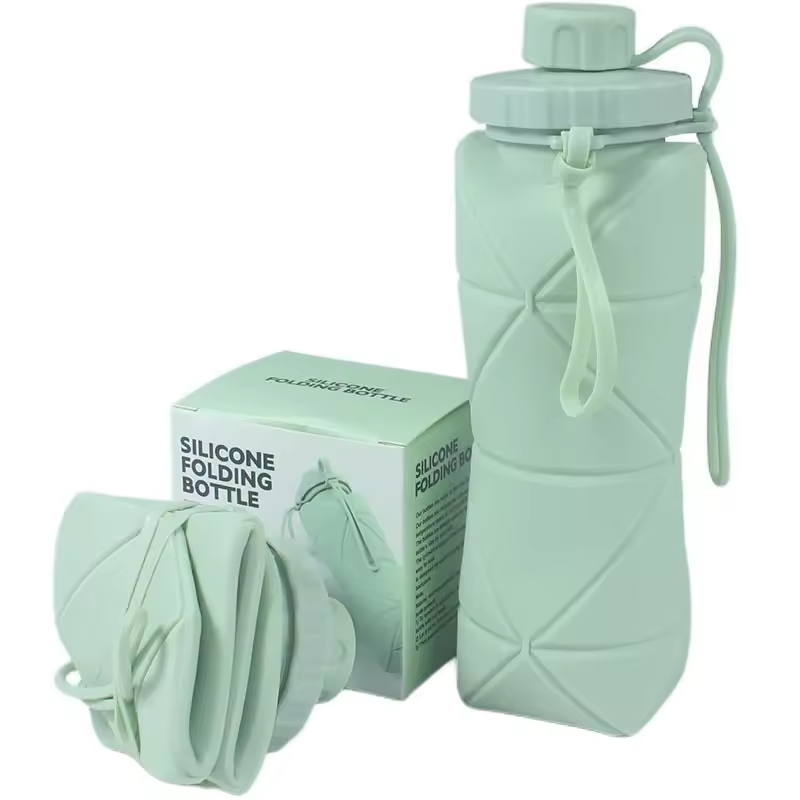
Reusable tote bag — folds down small, weighs almost nothing, and saves on plastic shopping bags everywhere.
Stainless steel straw — comes with a cleaning brush and fits in any pocket.
Bamboo cutlery set — fork, knife, spoon, and chopsticks in a roll-up pouch. Great for street food or airport meals.
Beeswax wraps or silicone bags — replaces plastic wrap and zip-lock bags for snacks and leftovers.
Microfiber towel — light, quick-drying, and requires almost no space. Many hotels provide towels, but having your own means no need to request extra laundry.
Keep It Light — Don’t Overdo It
You want to substitute out disposables, not add a lot of weight. Choose items that are:
- Lightweight (under 100g each when possible)
- Multipurpose (a stainless-steel bottle works for hot drinks too)
- Durable (quality over quantity — buy once, keep for years)
A good reusable kit weighs less than 500g total. That’s nothing in a travel bag, and the environmental savings are huge.
Tip 4: Bring a First Aid and Medicine Kit to Avoid Buying Prepackaged Products Abroad
This one surprises a lot of people — but it’s a genuinely smart eco-friendly travel packing tip.
When travelers fall ill or become injured abroad, they frequently turn to tourist pharmacies selling single-use, over-packaged products — everything wrapped in plastic and cardboard, and priced three times higher than at home.
Eco Travel First Aid Kit Essentials
Pack small quantities of what you actually need:
| Item | Why It Matters |
|---|---|
| Pain reliever tablets | Avoids buying packaged pills abroad |
| Adhesive bandages | A few go a long way |
| Antidiarrheal tablets | Common need, simple fix |
| Antihistamine tablets | For allergies or insect bites |
| Small reusable ice pack | Eco alternative to chemical packs |
| Antiseptic wipes | Individually wrapped, minimal waste |
| Any personal prescriptions | Always pack enough for the full trip |
Keep it in a small zippered pouch. It takes almost no space and can save you from purchasing wasteful, overpackaged products on the road.
Tip 5: Use Packing Cubes and Roll Your Clothes — Fit 30% More in the Same Space
This tip is about technique — and it changes everything.
Two tools work together beautifully here: packing cubes and the rolling method.
Why Packing Cubes Are an Eco-Friendly Travel Packing Tool
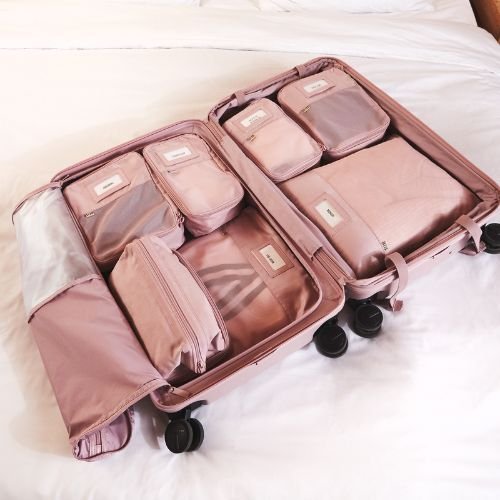
Wait — packing cubes are eco-friendly? Yes, here’s why.
When you organize well, you see clearly what you have. That stops you from overpacking “just in case.” It also means you can use a smaller bag, which may allow you to bypass checked luggage altogether and fly carry-on only.
Flying carry-on only reduces luggage weight per passenger, which contributes to lower fuel consumption across the plane. Small impact per person — but multiply that by millions of flights and it becomes significant.
The Rolling Method vs. Folding
| Method | Space Used | Wrinkles | Organization |
|---|---|---|---|
| Flat folding | More space | More wrinkles | Harder to find items |
| Rolling | 30% less space | Fewer wrinkles | Easy to see |
| Bundle wrapping | Least space | Fewest wrinkles | Complex to set up |
Rolling is easy to do and remarkably efficient. Roll each item tightly and store the rolls upright in your packing cube. You’ll fit far more than you expect.
How to Pack Cubes Into Your Bag
Designate different cubes for each category:
- Cube 1: Tops and underwear
- Cube 2: Bottoms and layers
- Cube 3: Electronics and cables
- Cube 4: Toiletry bag
This system means you can retrieve things at lightning speed — no more rummaging through your bag.
Look for packing cubes crafted from recycled materials or sustainable fabrics. A few eco-conscious brands now offer exactly that.
Tip 6: Go Digital — No Paper Waste Before You Even Begin Your Adventure
Paper waste is a quiet travel problem that doesn’t receive much attention. Consider all the things you used to print:
- Flight tickets
- Hotel confirmations
- Tour bookings
- Maps
- Itineraries
- Travel insurance documents
That’s a lot of paper. And much of it gets crumpled, lost, or thrown away within hours.
The Digital Traveler’s Toolkit
Going digital is one of the easiest eco-friendly travel packing tips because it doesn’t require buying anything new — you probably already have everything you need.
Download your boarding passes. Every major airline has an app. Scan from your phone at the gate.
Use Google Maps offline. Download maps of your destination before you leave so you don’t need data or paper maps on arrival.
Store documents in the cloud. Keep your passport photo, travel insurance, hotel confirmations, and emergency contacts in Google Drive or a similar service. Access them from any device.
Use a travel app like TripIt. It organizes your entire itinerary in one place — flights, hotels, activities — all without a single piece of paper.
Carry an e-reader instead of books. One Kindle or tablet holds thousands of books. No paper, no weight.
A Note on Screen Time and Battery
Going fully digital places more strain on your phone or tablet. Pack a solar-powered or hand-crank charger to top up your devices without drawing from the electrical grid. It’s a perfect eco-travel companion.
Tip 7: Opt for Eco-Certified and Ethically-Made Gear — Buy Less, Buy Better
The gear you pack is almost as important as how you pack it.
Fast fashion and poor-quality travel items deteriorate quickly. That translates to more waste, more shopping, and more resources consumed over time. Eco-minded travelers flip this by starting out with high-quality, ethical gear from the start.
What to Look for When Buying Travel Gear
Certifications to trust:
- Bluesign — for sustainable textile manufacturing
- Fair Trade Certified — ethical labor practices
- Global Organic Textile Standard (GOTS) — organic fiber, responsible production
- B Corp Certified — companies meeting high standards of verified social and environmental performance
Materials to prioritize:
- Recycled nylon or polyester (from reclaimed ocean plastic or bottles)
- Organic cotton
- Hemp fabric (low water use, naturally pest-resistant)
- Tencel / Lyocell (biodegradable, produced in a closed-loop system)
Eco-Friendly Travel Gear Brands Worth Knowing
Several brands are paving the way in sustainable travel gear. Explore options from companies like Patagonia, Cotopaxi, Tentree, and Girlfriend Collective — all of which use recycled or ethical materials with transparent supply chains.
You don’t have to replace everything all at once. The rule is simple: when something wears out, replace it with a more sustainable version.
The “One In, One Out” Rule for Eco Travelers
Before adding any new item to your travel kit, ask: Am I replacing something that’s worn out, or am I just buying something new?
If it’s the latter, skip it. Consuming less is always the most eco-friendly choice.
At a Glance: 7 Eco-Friendly Travel Packing Tips
| # | Tip | Key Benefit |
|---|---|---|
| 1 | Build a capsule wardrobe | Fewer clothes, lighter bag |
| 2 | Switch to solid toiletries | Zero plastic waste |
| 3 | Pack a reusable kit | Replaces hundreds of disposables |
| 4 | Carry a mini first aid kit | Avoids over-packaged pharmacy products |
| 5 | Use packing cubes + rolling | Pack 30% more, consider carry-on only |
| 6 | Go fully digital | Eliminates paper waste entirely |
| 7 | Buy ethical, eco-certified gear | Less waste, higher quality, longer lifespan |
How These Tips Work Together
Here’s what’s powerful about these tips: they compound.
When you use a capsule wardrobe, you pack fewer clothes. When you pack fewer clothes, you need less space. When you need less space, you can fly carry-on only. Flying carry-on only reduces weight on the plane. Less weight means less fuel burned.
That’s a domino effect triggered by one small decision at the very start.
Add solid toiletries, a reusable kit, and eco-certified gear, and you’ve built a travel routine that’s genuinely greener — not just convenient, but truly kind to the environment.
For more inspiration on sustainable travel planning, gear guides, and destination ideas, visit Eco Friendly Travel — your go-to resource for greener adventures around the world.
FAQs About Eco-Friendly Travel Packing
Q: Is eco-friendly travel gear more expensive?
Sometimes upfront, yes. But it lasts much longer. A $40 merino wool t-shirt worn 100 times costs far less per wear than a $10 fast-fashion shirt that falls apart in a year. Think cost-per-use, not sticker price.
Q: Can one still be stylish with a capsule wardrobe?
Absolutely. Whole aesthetics, from travel influencers to fashion bloggers, have been built on living out of a suitcase. Neutrals and classic cuts are always more timeless — and flattering, for that matter.
Q: What is the single most effective change I can make?
Using a water bottle with a filter. It cuts out plastic bottle buying for your entire trip — often dozens of bottles a week.
Q: Are solid shampoo bars good for all hair types?
Most do, although there’s a brief scalp adjustment period (generally 1–2 weeks). Test the bar at home before you go so you’re not adjusting on the road.
Q: How do I do carry-on only for longer trips?
Opt for quick-dry fabrics, schedule laundry stops every 4–5 days, and adopt the capsule wardrobe method. Most destinations have laundromats, hostels with laundry facilities, or sink-wash options.
Q: Are bamboo products really eco-friendly?
Bamboo grows quickly with minimal water and no pesticides — so far, so good. The eco impact varies with processing. Look for OEKO-TEX certified bamboo fabrics to ensure the manufacturing process has also been kept clean.
Q: What can I do to minimize plastic use when I travel?
Begin with your water bottle, then your toiletries, then your food storage. Those three swaps alone eliminate the biggest portion of single-use plastic most travelers generate.
One Last Thing: Small Choices, Real Impact
Eco-friendly travel packing isn’t about getting it all perfect. It’s about being intentional.
You don’t need to overhaul everything all at once. Pick one or two tips from this list and begin there. Swap your toiletries for solid bars. Roll your clothes and see if you can go carry-on only the next time you take a short trip. Download your boarding pass to your phone instead of printing it.
Each small choice adds up. Across thousands of trips a year, travelers who pack smart and pack light really do make a difference.
The world’s most beautiful places — the ones we travel to see — deserve that effort. And honestly, traveling light just feels better. Less to carry, less to worry about, more room to enjoy the journey.
Pack smart. Travel light. Leave it better than you found it.