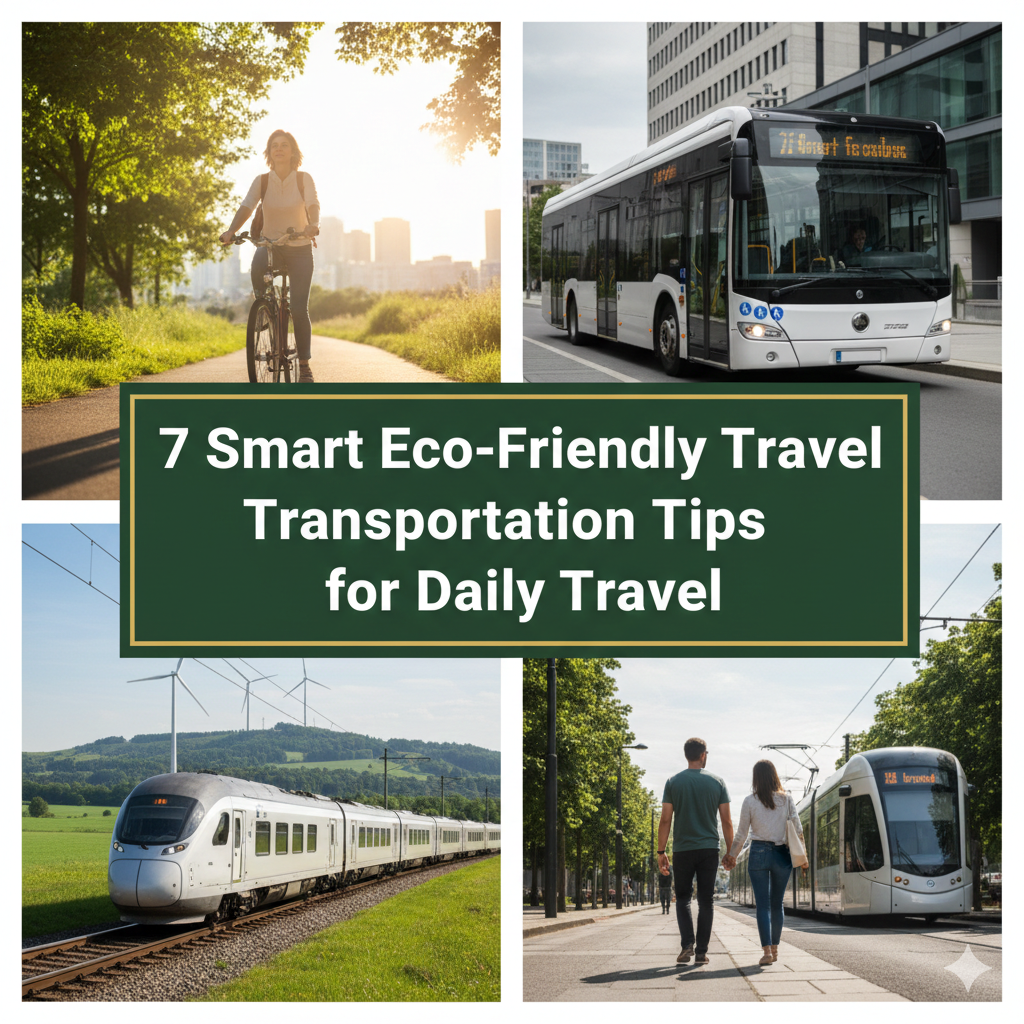



The vast majority of people want to travel more responsibly. But when you go looking for advice online, it can leave you feeling overwhelmed. Carbon calculators. Offset programs. Sustainability certifications. It’s a lot to take in.
Here’s the real deal: you don’t need an environmental science degree to be eco-friendly on your travels. That doesn’t mean sacrificing comfort, adventure, or the destinations on your bucket list.
It means making a couple of smarter choices about how you travel.
These 5 eco-friendly travel transportation tips are actionable, simple, and can be adopted by anyone — whether you’re a first-time traveler or have been exploring the world for decades. Each is something you can act on right now, beginning with your very next trip.
Let’s get into it.
Why How You Get There Matters Just as Much as Where You’re Going
Before the tips, a word about the bigger picture.
Tourism is one of the fastest-growing industries in the world. Millions are visiting and discovering new destinations every single day. That’s a beautiful thing. But it comes with a real environmental cost.
The largest chunk of that cost is transportation. It’s not the hotel you stay in or the food you eat that most contributes to your carbon footprint — it’s how you get from point A to point B.
Aviation alone contributes roughly 2.5% of the world’s CO₂ emissions, according to Our World in Data. That figure increases sharply when the other climate effects of flying at high altitude are taken into account. Road transport adds even more to the total.
Here’s a basic comparison of various modes of transportation:
| Transport Type | CO₂ per Passenger (per km) | Eco Rating |
|---|---|---|
| Domestic Flight | ~255g | Very High Impact |
| Long-Haul Flight | ~195g | Very High Impact |
| Gasoline Car (solo) | ~192g | High Impact |
| Gasoline Car (4 passengers) | ~48g | Moderate Impact |
| Bus (coach) | ~27g | Low Impact |
| Electric Train | ~14–41g | Very Low Impact |
| E-Bike | ~8g | Near Zero |
| Bicycle | 0g | Zero Impact |
| Walking | 0g | Zero Impact |
Source: Our World in Data, European Environment Agency
The gap from the top to the bottom of that table is vast. And each time you choose a bus or a train over a car or a plane, you are making an actual difference.
Now, here’s how to do it.
Tip 1: Swap a Plane for a Train and Shrink Your Carbon Footprint
This is the single strongest change on this entire list.
One train ride instead of one flight can reduce the carbon impact for that trip by 80–90%. That’s not a small improvement. That’s a transformation.
And the even better news is that train travel has never been easier, more comfortable, or more widely available than it is right now.
The Train vs. Plane Reality Check
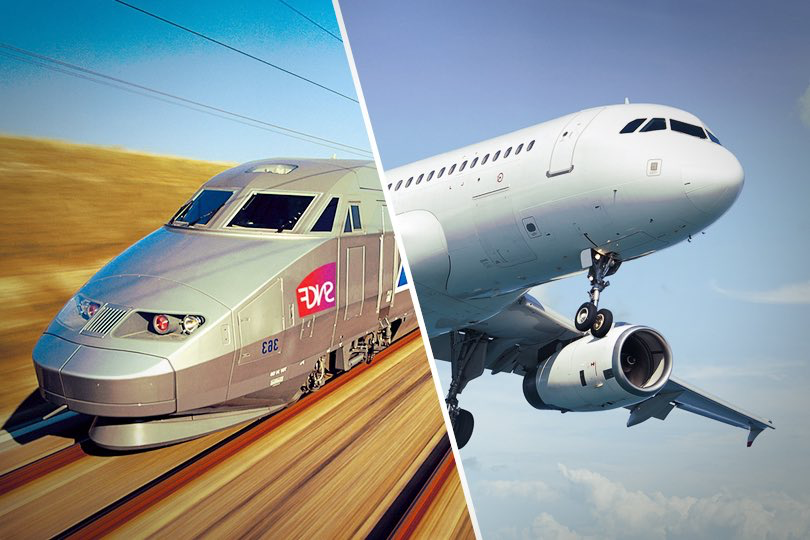
Flying is often the first option people think of — especially for medium-distance trips. But when you stack up the whole picture, trains frequently come out on top.
Think about what flying really involves. You have to arrive at least 90 minutes early. You go through security. You wait at the gate. You board, taxi, and take off. You land, disembark, collect your luggage, and make your way from the airport into the city center.
A flight between two cities 500 km apart may take an hour in the air. But door to door? You’re often looking at 4–5 hours.
A high-speed train between the same two cities? You board in the city center, ride comfortably, and arrive in another city’s center. Sometimes in less total time than flying.
Train Routes Where Rail Trumps the Plane
Here’s a look at some popular routes where taking the train is faster or roughly equal to flying:
| Route | Train Time | Flight Time (Door to Door) | CO₂ Saved by Train |
|---|---|---|---|
| London → Paris | ~2h 20min | 4–5 hours | ~90% less |
| Tokyo → Osaka | ~2h 30min | 3.5–4 hours | ~85% less |
| Barcelona → Madrid | ~2h 30min | ~4 hours | ~88% less |
| Amsterdam → Brussels | ~1h 50min | ~3.5 hours | ~90% less |
| NYC → Washington D.C. | ~3 hours | 4–5 hours | ~83% less |
Estimates based on door-to-door travel including airport time
The rule of thumb used by many sustainability experts is simple: if the train takes fewer than 5 hours, skip the flight.
Making Train Travel Work for You
Booking a train trip doesn’t have to be complicated. Here are some starter tips:
- Use Trainline, Omio, or Rail Europe to compare and book train routes across Europe
- Book in advance for the best prices — just like flights, train fares go up closer to the date
- Look into rail passes if you’re planning a multi-city trip (Eurail Pass for Europe, JR Pass for Japan)
- Check if overnight trains are available — you save a hotel night and travel while you sleep
Overnight trains in particular are experiencing a huge renaissance across Europe. Routes between Vienna, Paris, Berlin, Amsterdam, and Rome are expanding. It’s one of the most romantic and eco-friendly ways to travel.
Tip 2: Use Public Transportation Like a Local — Not Like a Tourist
Landing in a new city and immediately renting a car feels natural. It feels safe. You’re in control, you can go anywhere, and you don’t have to figure out an unfamiliar transit system.
But that rental car? It’s one of the most high-impact decisions you can make as a visitor.
A solo traveler behind the wheel of a rental car generates more CO₂ per kilometer than almost any form of public transit. Buses, metros, trams, and trains carry dozens or hundreds of passengers — spreading the emissions across every person on board.
And the truth is, public transportation in most tourist destinations is incredibly easy to use.
Cities Where You’ll Never Need a Car
Some of the world’s most-visited cities also have the most impressive transit systems:
| City | Key Transit System | Tourist-Friendly? |
|---|---|---|
| Tokyo, Japan | Metro + Shinkansen rail | ⭐⭐⭐⭐⭐ |
| Vienna, Austria | U-Bahn + Trams | ⭐⭐⭐⭐⭐ |
| Singapore | MRT (Mass Rapid Transit) | ⭐⭐⭐⭐⭐ |
| Amsterdam | Trams + Metro + Buses | ⭐⭐⭐⭐⭐ |
| Medellín, Colombia | Metro + Cable Cars | ⭐⭐⭐⭐ |
| New York City | Subway + Buses | ⭐⭐⭐⭐ |
| Berlin, Germany | U-Bahn + S-Bahn + Trams | ⭐⭐⭐⭐⭐ |
Tourists aren’t just tolerated on public transit in these cities. They’re designed for it.
Your Game Plan: How to Get Around Without a Car at Your Destination
Getting off to a good start makes all the difference. Here’s a simple approach:
Before you leave home:
- Research which app covers transit in your destination city (Google Maps works nearly everywhere, but a local app is often better)
- Look into tourist transit passes — many cities sell unlimited-ride cards for 24, 48, or 72 hours at very low cost
- Find out if your accommodation is close to a metro or tram stop — this one choice shapes how you’ll get everywhere on your trip
When you arrive:
- Go directly to the transit information desk or kiosk at the airport or train station
- Get a transit card and load enough credit for a couple of days
- Download the transit map offline so you can navigate without draining your data
During your trip:
- Default to transit for anything over 15 minutes on foot
- Ask locals, not just Google — they know which bus is actually reliable
- Embrace the adventure of figuring it out — some of the best travel stories begin with “We took the wrong metro line and ended up…”
Eco-friendly travel transportation is often just local transportation. You’re not doing anything unusual. You’re just moving around the way millions of residents already do every single day.
Tip 3: Walk and Cycle Your Destinations — Zero Emissions, Maximum Experience
Here’s a transportation tip that costs nothing, produces zero emissions, keeps you healthy, and almost always leads to the most memorable moments of any trip.
Walk more. Cycle when walking isn’t enough.
Tourists have a habit of moving too fast. They take a taxi to a restaurant 800 meters away. They hop on the metro for two stops. They miss everything in between — the street art, the bakery that smells incredible, the courtyard hidden behind an unassuming door.
What You Lose When You Don’t Walk
Walking is not just a way to get somewhere. It’s a way to literally experience a place.
Every city has a texture that only reveals itself at walking pace. The sound levels change block by block. The architecture shifts from street to street. The light on a canal or a market square — you can’t appreciate it at speed.
A simple mindset shift makes all the difference: choose walking as your first option, not your last resort.
Set a personal rule for your trip. Anything within a 20-minute walk? Walk it. You’d be amazed how far that gets you — and how much richer your experience becomes.
Cycling: More Ground, Same Spirit

When destinations are spread a little further apart, a bike fits perfectly between walking and taking the bus.
Cycling lets you cover 3–4 times the ground of walking while still moving slowly enough to notice and enjoy everything around you. You can stop whenever you want, change direction on a whim, and explore areas where buses and taxis never go.
Here’s a brief guide to city cycling options in most tourist destinations:
| Option | How It Works | Best For |
|---|---|---|
| Docked Bike Share | Pick up and return to fixed stations | Short city hops |
| Dockless Bike Share | Pick up/drop off anywhere via app | Flexible exploring |
| E-Bike Rental | Pedal-assist makes hills a breeze | Longer distances |
| Guided Cycling Tour | Group ride with a local guide | First-timers, history buffs |
| Hotel/Hostel Bike Loan | Free bikes from accommodation | Budget travelers |
Top bike-friendly cities for tourists:
- Amsterdam, Netherlands
- Copenhagen, Denmark
- Utrecht, Netherlands
- Portland, Oregon (USA)
- Bogotá, Colombia
- Kyoto, Japan
- Montreal, Canada
These cities all have cycling paths completely separated from traffic. You don’t have to be a regular cyclist to feel safe.
Prep for Walking and Cycling Success
A couple of practical notes:
Pack one good pair of walking shoes. Not stylish ones. Comfortable ones. Your feet will carry you through everything — poor footwear has ruined more trips than bad weather.
Download Maps.me or save Google Maps offline before you arrive. This lets you navigate without draining your data plan, and it works even when there’s no consistent signal.
If you find yourself cycling in an unfamiliar city, take 10 minutes on your first morning to ride around a quiet area near your accommodation. Get comfortable with the local traffic rhythm before heading somewhere busier.
Tip 4: If You Need a Car, Make It an Electric or Shared One
Sometimes a car is genuinely necessary. Remote national parks, rural countryside, places with no transit infrastructure at all — there are parts of the world where a car is really the only option.
That doesn’t mean you need to resort to a gas-guzzling SUV.
The car rental industry has changed significantly in recent years. Electric and hybrid vehicles are now widely available through major rental companies in most tourist destinations. And choosing one makes a real difference.
Electric vs. Gasoline: What the Numbers Actually Show
Here’s how an electric vehicle compares to a standard gasoline rental on a typical tourist road trip:
| Factor | Gasoline Car | Electric Vehicle |
|---|---|---|
| Tailpipe CO₂ Emissions | ~192g per km | 0g per km |
| Total Lifecycle CO₂ | ~192g per km | ~47g per km* |
| Fuel Cost | Higher (gas prices vary) | Lower (electricity cheaper) |
| Maintenance | More complex | Simpler |
| Driving Experience | Standard | Quiet, smooth |
Based on average electricity grid mix — cleaner grids produce even lower emissions
The lifecycle number for EVs includes the emissions from generating the electricity used to charge them. Even on a grid partly powered by fossil fuels, EVs win the emissions comparison easily.
How to Rent an EV Without the Headaches
The top concern tourists have about renting an EV is charging. Where do you plug in? What if your battery dies in the middle of nowhere?
These are fair questions. Here’s how to handle them:
Before you pick up the car:
- Download the PlugShare app — it maps every charging station worldwide
- Ask the rental company which charging networks are compatible with the vehicle
- Plan your route with charger locations in mind, just as you would with gas stations
During your trip:
- Charge at your accommodation overnight whenever possible — most hotels now offer EV charging
- Don’t wait until the battery is almost empty to look for a charger (aim to charge when you’re at 20–30%)
- Use the car’s built-in navigation to find chargers along your route
If EVs aren’t available:
- Choose a plug-in hybrid as your second option
- Choose a standard hybrid as your third option
- If none of the above are available, pick the smallest gasoline car that fits your needs — a compact uses significantly less fuel than a full-size SUV
Share the Road, Share the Impact
If you’re traveling with others, carpooling is one of the smartest eco-friendly travel transportation moves you can make.
Four people in one car means each person produces about one quarter of the emissions of four people in four separate cars. The math is simple. The savings are real.
Apps like BlaBlaCar connect travelers heading in the same direction for longer intercity journeys. It’s widely used across Europe and expanding into other regions. You share the journey of someone already making the trip — meaning no new emissions are created purely for your benefit.
For shorter city trips, UberPool and Lyft Shared match you with other riders going in the same direction. Not always perfectly convenient, but noticeably greener than a private ride.
Tip 5: Plan a Smarter Route Before You Leave — What You Design at Home Shapes Everything
This one happens before you even start packing.
Most travelers choose their destinations and then book transport. They don’t carefully think through the order in which they visit places, and the result is an enormous amount of avoidable travel — double-backs, duplicate flights, unnecessary long drives.
A little planning before you leave home can shave hundreds or even thousands of unnecessary kilometers off your trip.
The Problem With Random Itinerary Planning
Picture a tourist preparing for a two-week European trip. They want to see London, Amsterdam, Paris, and Rome.
A poorly planned route might look like this: London → Paris → London → Amsterdam → London → Rome → Home
That routing has you returning to London three times — once after Paris, once after Amsterdam, and the original departure. It adds hours of travel and significant unnecessary emissions.
A smarter version: London → Amsterdam → Brussels → Paris → (fly once) → Rome → Home
Same four cities. One logical sweep across the continent. One flight instead of three. Dramatically fewer total kilometers.
How to Build a Low-Impact Itinerary
Follow this simple process for any multi-destination trip:
Step 1: List your destinations Write down everywhere you want to go, in no particular order.
Step 2: Map them geographically Use Google Maps or a world map to see how they relate to each other physically. Which ones are close together? Which ones are between others?
Step 3: Build a logical arc Arrange your destinations in a route that flows geographically — either a loop that returns to where you started, or a line that progresses logically from one side of a region to another.
Step 4: Identify where trains replace flights Go through each leg of your route. Could any flight be replaced with a train journey under 5 hours? Replace it.
Step 5: Use planning tools
- Rome2Rio shows every transport option between any two points in the world, with emissions estimates
- Google Flights lets you compare routing options visually on a map
- Omio combines trains, buses, and flights in one search
Step 6: Book anchor transport first Book your long-distance transport (international flights or long train journeys) before your accommodation. It’s easier to adjust where you stay than to change your core travel structure.
Smart Routing vs. Unplanned Routing: How They Compare
| Itinerary Type | Extra km Traveled | Extra CO₂ Produced | Cost Impact |
|---|---|---|---|
| Randomly planned | Often 40–60% more | Significantly higher | Much higher |
| Logically planned (loop) | Baseline | Baseline | Lower |
| Logically planned (linear) | Minimal extra | Near baseline | Lowest |
The difference in emissions between a chaotic itinerary and a logical one can be the equivalent of an entire extra long-haul flight. That’s not a small number.
For more guides, resources, and ideas on traveling sustainably, visit Eco Friendly Travel — a helpful hub for tourists who want to explore the world without harming it.
Putting It All Together: Your 5-Tip Quick Reference
Here’s a fast summary of every tip in one easy-to-scan format:
| # | Tip | Best Impact Level | Difficulty |
|---|---|---|---|
| 1 | Swap a flight for a train | ⭐⭐⭐⭐⭐ Massive | Easy |
| 2 | Use public transit at your destination | ⭐⭐⭐⭐ High | Easy |
| 3 | Walk and cycle whenever possible | ⭐⭐⭐ Medium-High | Very Easy |
| 4 | Choose EVs or shared cars when a car is needed | ⭐⭐⭐ Medium-High | Easy |
| 5 | Plan a logical route before leaving home | ⭐⭐⭐⭐⭐ Massive | Moderate |
You don’t need to do all five on your first trip. Begin with whatever feels easiest. Then add another on the trip after that. In time, these choices become second nature.
FAQs About Eco-Friendly Travel Transportation
Q: Are eco-friendly transportation options always more expensive? Not at all. Trains and buses are often cheaper than flights, particularly in Europe and Asia. Walking and cycling cost almost nothing. Planning a smarter route can actually save hundreds on unnecessary bookings.
Q: What if I’m traveling somewhere with no trains or public transit? It happens — especially at out-of-the-way or rural destinations. In those cases, rent an EV or hybrid, carpool with fellow travelers, and plan your route carefully to minimize total distance driven.
Q: How do I know if my train trip is actually greener than flying? For nearly every journey under 1,000 km, the train wins on emissions — often by a huge margin. You can check specific routes using the carbon calculator at EcoPassenger.org, which compares train and flight emissions directly side by side.
Q: Is cycling safe for tourists in unfamiliar cities? Yes, in most tourist-friendly cycling cities. Stick to marked bike lanes, take it slow in unfamiliar areas, and do a short test ride near your accommodation first. E-bikes are a great option if you’re not a confident cyclist.
Q: How much does smarter route planning actually reduce emissions? Poorly optimized multi-destination trips can generate 40–60% more transport emissions than logically planned ones. Removing just one unnecessary flight from a trip can save 200–400 kg of CO₂ per person.
Q: Can eco-friendly travel transportation really make a difference at scale? Yes. Tourism accounts for roughly 8% of global greenhouse gas emissions, with transport being the largest portion. When millions of travelers each make smarter choices, the collective impact is genuinely significant.
Q: What’s the easiest first step for someone new to eco-friendly travel? Walk more. It’s free, requires no planning, and immediately shrinks your footprint. From there, try replacing one car trip or short flight with public transit or a train.
The Big Picture: Travel Is Worth Protecting
This is worth sitting with for a moment.
The reason eco-friendly travel transportation matters — the deeper reason — is that the places worth traveling to are among those most threatened by climate change.
Coastal cities. Coral reefs. Mountain villages. Rainforests. Polar regions. The most spectacular destinations on Earth are also the most vulnerable to the warming caused by, among other things, the emissions from getting there.
Traveling more responsibly isn’t just about reducing a number on a carbon calculator. It’s about protecting the places you love enough to visit in the first place.
These five tips won’t single-handedly stop climate change. Nothing this simple could. But they are real, practical, and available to everyone. And when millions of travelers start making them together, the effect is genuinely meaningful.
You don’t need to choose between a love of travel and concern for the planet. You just have to travel a little smarter.
Start with one tip. Take the train on your next trip. Walk to dinner instead of calling a cab. Choose the metro over the rental car.
Every small shift counts. And the path toward more responsible travel is, in its own right, a kind of adventure worth taking.