
When you book a flight or reserve a rental car, you make an imprint on the planet. That mark is your carbon footprint — and for many travelers, it’s larger than they think.
The good news? You don’t have to give up traveling. You just have to be a smarter traveler.
Eco-friendly travel is growing fast. More people are seeking green ways to get around — and not just because it makes them feel good, but also because it often saves money. Whether it be for a weekend road trip or an international exploration, the small things do add up to make quite a difference.
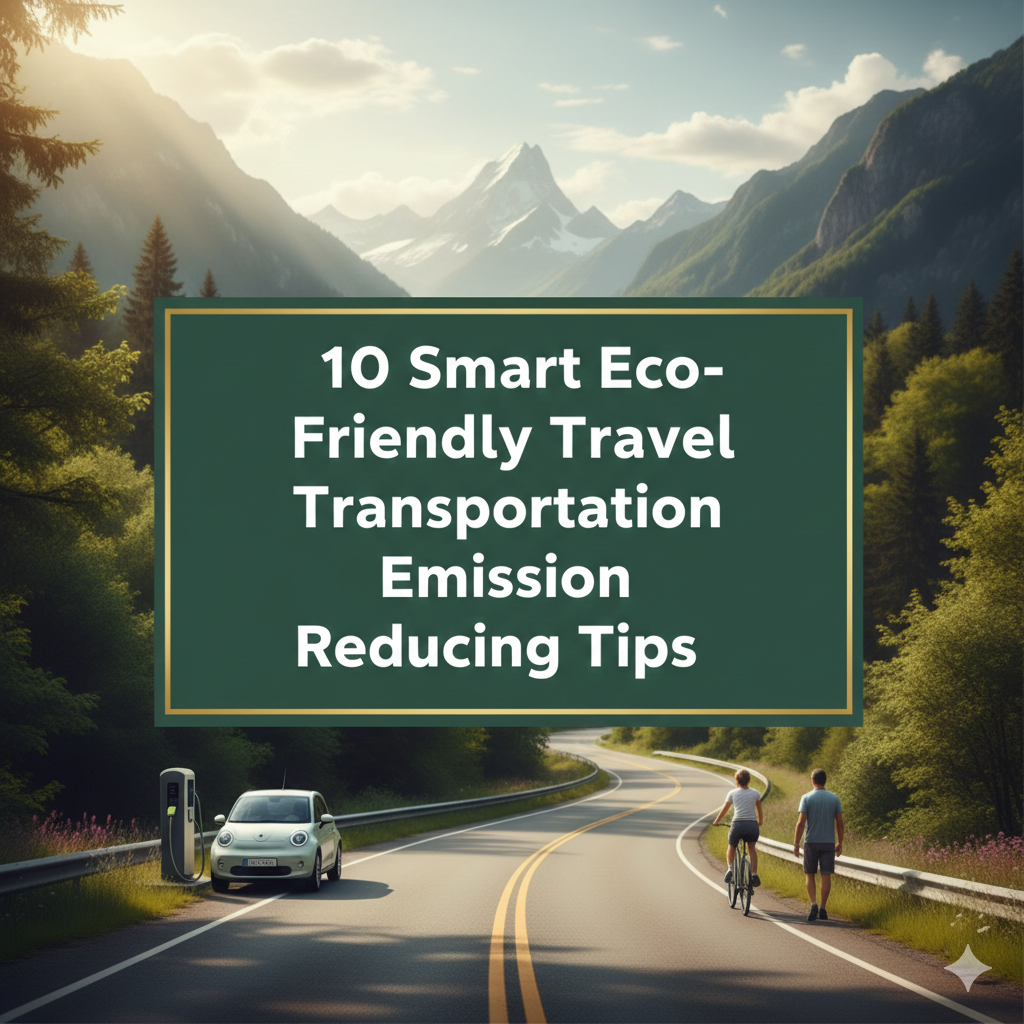
This guide offers 10 tips for getting around that are simple, doable, and have a substantial payback in emissions — without ruining your days and nights away. Let’s get into it.
Your Travel Choices Matter More Than You Think
Transportation is one of the largest contributors to greenhouse gas emissions around the world. Transport is responsible for about 37% of all CO₂ emissions deriving from the consumption of energy. Aviation is responsible for something in the order of 2.5% of all global CO₂ emissions — and considerably more when you add other climate-warming effects at high altitude.
Here is a brief comparison of different transport types:
| Transport Type | Avg. CO₂ per Passenger per km |
|---|---|
| Short-haul flight | 255g |
| Long-haul flight | 195g |
| Petrol car (1 person) | 192g |
| Electric Car | 70g |
| Coach/Bus | 27g |
| Train (EU avg.) | 14g |
| Cycling | 0g |
These numbers leave no doubt: how you get around makes all the difference. Now let’s get to what you can actually do about it.
Tip 1: Train Over Plane Whenever You Can
If there’s one swap that does the most for the environment, it’s taking trains over planes for short to medium distances.
A train from London to Paris produces roughly 90% less CO₂ than a plane flying the same route. That’s not a slim margin — that’s a huge gap.
When Is the Train Better Than the Plane?
Trains are most sensible when:
- Your journey is less than 600 miles (about 1,000 km)
- There is a direct rail connection
- You also factor in getting to the airport, check-in, and security delays
In fact, the train is often faster door to door. And train stations tend to be right in the middle of town, so there’s less added travel at both ends.
There is an excellent rail network across Europe. Japan, France, Spain, and Germany have fast, comfortable, and relatively affordable trains. Even in the US, Amtrak is a good option for certain corridors, such as the Northeast.
Pro Tip: Head to rail booking sites like Trainline, Omio, or Rail Europe to compare prices and routes across various countries all in one place.
Tip 2: If You Fly, Fly Smart
Sometimes flying is unavoidable. You can’t really travel long distances internationally without planes — at least not yet. But harm can still be mitigated.
Choose Economy Class

It’s simple, but it makes all the difference. Business and first class occupy more actual space on a plane. More space per passenger results in a higher share of emissions per person.
Economy class can reduce your per-seat emissions by as much as 3x compared to first class on select airlines.
Fly Direct
Every takeoff and landing burns a ton of fuel. Connecting flights mean more takeoffs and landings. When possible, pick a non-stop flight — even if it costs more.
Pick Airlines With Modern Fleets
More modern planes, such as the Airbus A320neo or Boeing 787 Dreamliner, are far more fuel-efficient than older models. Some airlines release information about their fleets. It’s worth checking.
Consider Carbon Offsetting (With Caution)
Carbon offsetting involves payment into projects that reduce emissions elsewhere — such as reforestation or solar energy initiatives. It isn’t a perfect fix, but it is better than doing nothing.
Seek offsets verified by reputable bodies like Gold Standard or Verra.
Tip 3: Electric or Hybrid Rentals Are Better for the Environment
Road trips are awesome. They don’t have to be dirty.
If you are renting a car, ask for an electric vehicle (EV) or hybrid. The majority of large rental companies now offer them. An EV generates zero tailpipe emissions. A hybrid saves 30–50% fuel compared to a standard petrol car.
Tips for Renting an EV
- Use PlugShare or ChargeHub to plan your charging stops in advance
- Consider the car’s driving range — most newer electric models provide 200 to 300 miles per charge
- Check with the rental company about its charging policy (some offer free charging)
If EVs are not available wherever you’re visiting, a small and fuel-efficient petrol car is still better than driving around in a large SUV or pickup truck.
Tip 4: Use Public Transportation Like a Local
The most effective way to reduce emissions on any trip is often to skip the private car entirely and take public transit.
Buses, metros, trams, and commuter trains can hold dozens of people at a time — which helps spread emissions across more passengers and dramatically reduces your personal carbon share.
Cities With Excellent Public Transport
| City | Notable Green Transit Feature |
|---|---|
| Tokyo, Japan | Highly punctual, massive rail network |
| Amsterdam | Integrated tram, bus, and metro system |
| Zurich | Near-perfect on-time public transport |
| Singapore | 100% air-conditioned MRT network across the city |
| Bogotá, Colombia | TransMilenio BRT covering the entirety of the city |
Most cities now have apps that make navigating public transit easy — Google Maps works in many places, and local apps are often even more useful.
Bonus: Public transportation also relieves you of the stress of driving in a foreign city.
Tip 5: Rent a Bike or Scooter for Short Distances
For shorter distances within a city or town, nothing beats a bike or e-scooter. They produce zero direct emissions and are incredibly convenient.
Hundreds of cities have bike-share programs. Companies like Lime and Bird, along with local city systems, have made it easy to grab a ride without owning a vehicle.
Why Cyclists Love This Travel Tip
- It’s inexpensive — often just a dollar or two per ride
- You can explore areas where cars and buses can’t easily go
- It’s great exercise
- You see more of a city at a human pace
If you’d rather not work too hard, an e-scooter or e-bike is a fine alternative. They’re electric, so emissions are minimal, and they’re perfect for hilly cities or longer urban distances.
Tip 6: Combine Trips and Map Your Routes Efficiently
Inefficiency is one of the sneakiest sources of travel emissions. Making three separate trips when you could have combined them into one wastes fuel, time, and money.
How to Design a Lower-Emission Itinerary
Before you book, plot your whole journey. Look for:
- A sensible geographic route (avoiding unnecessary zigzagging)
- Opportunities to combine city visits in one rail or bus pass
- Multi-city flight deals instead of returning home between legs
This kind of “slow travel” approach — spending more time in fewer places — is one of the most effective eco-friendly travel strategies out there. You travel less overall, but experience more.
Tip 7: Pack Light to Reduce Fuel Burn

This one surprises a lot of people. How much your luggage weighs directly influences emissions.
More fuel is required to carry extra kilograms on a plane. The same reasoning holds true for the burden on a bus or train. Taken individually, one bag might not seem like much. But multiplied by hundreds of passengers, it adds up quickly.
The Carry-On Challenge
With smart packing, traveling with just a carry-on for up to two weeks is very doable. Benefits include:
- Faster boarding and arrival
- No checked baggage fees
- Lesser contribution to total fuel use
- Less chance of lost luggage
Pack versatile clothes, use packing cubes, and be smart about toiletries. This is one of the lowest-hanging wins on this list.
Tip 8: Choose Eco-Friendly Ferries and Boats When Crossing Water
Ferries and boats are often the only practical means of travel between islands or along a coast. The great news is that ferry travel tends to be more environmentally friendly than flying over the same stretch of water.
Not All Boats Are Equal
Traditional diesel-powered cruise ships are actually among the worst emitters per passenger. They can produce more CO₂ per kilometer than flying, and also contribute to significant air and water pollution.
But modern electric and hybrid ferries tell a very different story. Countries like Norway are leading the way — their electric ferries can reduce emissions by up to 95% compared to diesel.
What to Look for When Booking Water Transport
- Electric or hybrid ferry operators
- Smaller, more efficient vessels
- Day ferries over overnight cruise options where possible
If you do want to take a cruise, look for companies with proven sustainability programs and newer, cleaner ships.
Tip 9: Walk More — It’s Free and Zero Emissions
Walking is the greenest form of getting around. It produces zero emissions, costs nothing, and is good for your health.
As a default, many travelers take taxis or rideshares for distances that are perfectly walkable. It may feel like a long walk if you’re used to jumping in a car, but in a new city, the walk is more likely to uncover things you’d never notice from inside a vehicle window.
Incorporate Walking Into Your Travel Plan
- Check walking times on Google Maps before defaulting to a cab
- Wear comfortable walking shoes — this is non-negotiable
- Download offline maps (Maps.me or Google Maps offline) so you can navigate without a data connection
- Plan your accommodation close to the attractions that matter most to you
Walkable neighborhoods also usually have better local restaurants, markets, and shops — so you get a richer experience at zero environmental cost.
Tip 10: Use the Power of Your Wallet to Support Green Transport
This last tip is bigger picture — and just as important as any of the rest.
Every travel purchase is a vote. When you opt for a bus-tour operator over a private helicopter tour, you send a market signal. When you book a train instead of renting a car, you invest in rail infrastructure. When you choose an airline with a credible sustainability plan over one that has none, you push the industry forward.
How to Vote With Your Travel Dollars
- Use flight booking platforms that display emissions data (such as Google Flights or Skyscanner’s carbon estimates)
- Leave reviews that mention eco-friendly transport options to influence other travelers
- Support local transport providers in developing countries, where your spending has direct community impact
- Choose tour operators certified by bodies like the Global Sustainable Tourism Council (GSTC)
Your individual decisions, multiplied across millions of travelers, determine what the travel industry offers next.
Quick Comparison: High-Emission vs. Low-Emission Travel
Here’s how two variations of the same trip might stack up in carbon output:
| Trip Element | High-Emission Version | Low-Emission Version |
|---|---|---|
| Getting there | Short-haul flight | High-speed train |
| Local transport | Rental SUV | Metro + e-bike |
| Luggage | 2 checked bags | 1 carry-on |
| City transfers | Taxi/rideshare | Walking + tram |
| Water crossing | Diesel-powered ferry | Electric ferry |
| Estimated CO₂ | ~1,200 kg | ~49 kg |
That’s approximately an 88% reduction — all from making smarter choices on the same trip.
FAQs About Eco-Friendly Travel Transportation
Q: Does sustainable travel cost more? Not necessarily. Trains, buses, and bikes tend to be cheaper than flying or renting a car. Upfront costs for EVs or certain eco-tours may be a little higher, but savings on fuel and parking usually offset that.
Q: What difference can I possibly make as a single traveler? Yes — individual choices create collective change. Millions of travelers making even a slight shift toward greener alternatives influence what airlines, rental companies, and tour operators provide. Your choices also affect the people around you.
Q: What is the one change that makes the biggest difference? If you fly, cutting back on flying or switching to rail for shorter trips is the single highest-impact change most travelers can make. Aviation carries a disproportionate share of travel-related emissions.
Q: Do carbon offsets really work? They’re controversial. Some offset programs are well-administered and genuinely reduce emissions. Others are poorly managed. If you use them, look for third-party verification through Gold Standard or the Verified Carbon Standard (VCS). Think of offsets as an add-on to reducing emissions — not a substitute.
Q: What’s “slow travel” and does it help the environment? Slow travel means spending more time in fewer places instead of rushing between many destinations. It often translates to less flying, more local transport, and a richer connection to each place. It’s nearly always more environmentally friendly — and many travelers say it’s also more enjoyable.
Q: How can I find out the emissions for my specific flight or train trip? CO₂ estimates for flights are displayed on Google Flights. Skyscanner also includes carbon comparisons. On the rail side, Eurostar and Deutsche Bahn publish emissions data on their websites. The EcoPassenger tool lets you compare rail, car, and flight emissions for European routes.
Q: Are electric vehicles always better for the environment? Generally yes, but it depends on how electricity is generated in that region. In areas powered mainly by coal, EVs have a less clear advantage. In places with lots of renewable energy, EVs are drastically cleaner. Even in average electricity grids, EVs still produce significantly fewer lifetime emissions than petrol cars.
The Bigger Picture: Travel Is Worth Preserving
The thing about eco-friendly travel — it’s not about guilt. It’s not about never leaving home or giving up adventures.
It’s about being thoughtful. It’s about understanding that the world’s most beautiful places — its coastlines, forests, mountains, and cities — are worth preserving. And that how we reach them has implications for whether they’ll still be there for those who come after us.
The 10 tips in this guide aren’t earth-shattering breakthroughs. They’re small, smart shifts. Take the train instead of the plane. Pack lighter. Walk more. Rent an e-bike. Choose the bus. Support the ones doing it right.
None of these things are vacation-ruiners. In fact, most travelers who go greener say their trips feel richer, slower, and more connected to the places they visit.
The world doesn’t need perfect travelers. It needs millions of slightly better ones. And that is something every one of us can do — beginning with the very next trip we plan.
Start small. Travel smart. Leave a lot less behind — except the footprints.