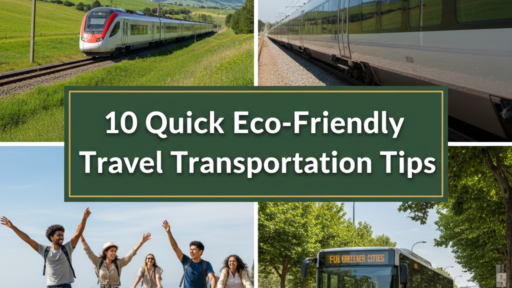


Transport is an essential part of modern travel.
Imagine it: You’re getting on a plane to the place you’ve longed to see, backpack slung over your shoulder, heart filled with anticipation. But at the back of your mind, a niggling thought slowly starts to form — what is this trip actually costing the planet?
Travel is one of the great pleasures of life. But it is also one of the largest sources of carbon emissions in the world. Transportation alone — airplanes, cars, cruise ships — is responsible for almost 16 percent of total global greenhouse gas emissions. That is a number that is hard to ignore.
The good news? You don’t have to pick between seeing the world and saving it. Green travel transportation is no longer a trend that only die-hard environmentalists participate in. It’s a realistic, affordable and increasingly widespread way of life that any traveler is capable of choosing.
This guide will provide you with 8 reliable, actionable tips to make your next vacation greener without compromising on fun, comfort or adventure. Whether you’re a weekend road tripper or a full-time nomad, these tips will help you travel smarter and with less of an impact on the planet.
Why the Way You Get to Your Travel Destination Matters
Before we begin, it helps to have a little context for why transportation is such a big deal when it comes to the environment.
When you burn fuel to get from point A to point B, you put carbon dioxide (and other greenhouse gases) into the atmosphere. These gases are heat-trapping and cause climate change. Various modes of transport emit vastly different quantities of CO₂.
| Mode of Transport | CO₂ per Passenger per km |
|---|---|
| Short-haul flight | ~255g |
| Long-haul flight | ~195g |
| Gasoline car (1 person) | ~192g |
| Bus | ~105g |
| Train (electric) | ~41g |
| Ferry/boat | ~19g |
| Cycling | 0g |
| Walking | 0g |
Source: Our World in Data / International Energy Agency estimates
As you can see, even small shifts in how you get around can have a big impact. Now let’s get into the tips.
Tip 1: Opt for Trains Over Planes Whenever Possible
The Rail Revolution Is Real

Trains are a venerable part of the eco-conscious traveler’s toolkit. Taking the train generates up to 80 percent less carbon emissions per passenger than flying. That’s not a slim margin — that’s enormous.
For trips of fewer than 500 miles (about 800 kilometers), trains often make more sense in many ways. They are cheaper, more pleasant, more comfortable and infinitely better for the planet.
Europe has one of the finest rail systems on Earth. Services such as London to Paris on the Eurostar or Amsterdam to Berlin are quick, cheap and far greener than flying. Shinkansen bullet trains in Japan make for another sound case. And in the United States, Amtrak routes along the Northeast Corridor provide a fairly sustainable alternative to short flights.
Making Train Travel Work for You
Book your tickets early for the best fares. Opt for rail passes if you’ll be traveling through several countries. Apps from Trainline, Omio or Rail Europe make it easier to compare routes and prices across borders.
Also, look into overnight trains. You save money on hotel costs while sleeping your way to a new destination — and reducing emissions in the process. That’s a double win.
Tip 2: Renting a Car? Go Electric or Hybrid
All Road Trips Are Not Created Equal
Sometimes a car is just the best choice — particularly in rural areas or locations with weak public transit. If you are hitting the road to visit national parks or remote off-the-beaten-path destinations, a car may be unavoidable.
But the car you choose matters a lot.
Electric vehicles (EVs) produce zero tailpipe emissions. Hybrid cars run on a combination of gas and electricity, so they consume much less fuel than traditional vehicles. Opting for either over a traditional gas-powered car can lower the carbon footprint of your journey by 40–70%, depending on your local energy grid.
Tips for Renting Green
Major rental companies — Enterprise, Hertz and Avis — now provide EV and hybrid fleets. During booking, filter directly for “electric” or “hybrid.” Websites like Rentalcars.com and Kayak allow you to filter by vehicle type.
Before you leave, map out your charging stops by using apps like PlugShare or ChargePoint. Charging infrastructure is expanding quickly in North America, Europe and some parts of Asia.
Also, consider the size. A smaller, lighter vehicle — even if it’s not a hybrid — uses less fuel than an SUV. If you’re traveling solo or as a couple, forgo the big car and save yourself money — and emissions.
Tip 3: Use Public Transportation Like the Locals Do
Buses, Metros, and Trams Will Be Your Green Best Friends

Here’s something most visitors don’t think about: public transportation is not only convenient — it’s one of the greenest travel transportation options out there.
A city bus can transport dozens of people at a time, spreading emissions across all of those people. The carbon footprint per person plummets compared to each rider driving alone. Urban metros and trams are even better, especially if they run on renewable electricity.
Travel by public transit and you will also experience the local culture. You will find neighborhoods that tourists in taxis don’t see. You’ll overhear conversations, spot street art and stumble upon that hidden café — all things you just can’t do from the window of a car.
Effortless Public Transit in a Strange New City
Many travelers avoid local transit because they’re afraid of getting lost or confused. Yet modern apps have made that incredibly easy.
Google Maps operates in nearly every major city and provides real-time public transit directions. Citymapper is great for urban environments such as London, New York, Paris and Tokyo. Many cities also have their own apps — TfL Go in London, for instance, or Transit in North America.
Get a transit card as soon as you land. Single tickets are generally more expensive and a bigger hassle to use. Cities such as Singapore, Hong Kong and Tokyo are renowned for their efficient, inexpensive and astoundingly green public transportation systems.
Tip 4: Find Your Way Around Your Destination on Foot or by Bike
Zero Emissions, Maximum Discovery
Nothing can top zero carbon emissions combined with real exploring. Both walking and cycling don’t just minimize your environmental impact — they offer a completely different experience of getting from point A to point B.
Cities including Amsterdam, Copenhagen, Utrecht and Portland have made big investments in cycling infrastructure. Bike lanes, bike-sharing programs and flat terrain make cycling easier than frustrating. In many cities in Asia — like Hanoi, Beijing and Chiang Mai — visitors can rent a bike affordably directly in tourist zones.
Walking is even simpler. Most city centers, old towns and historic districts are meant to be explored on foot anyway. You move at a human pace, you notice things, and in the process remain in decent shape.
Bike-Sharing Programs Worth Knowing
| City | Bike-Share Program | Cost (approx.) |
|---|---|---|
| Paris | Vélib’ | €5/day |
| New York | Citi Bike | $4.49/ride |
| Amsterdam | OV-fiets | €4.25/day |
| London | Santander Cycles | £2/ride |
| Melbourne | Melbourne Bike Share | Free (short rides) |
| Chengdu | DiDi Bike | ~$0.30/ride |
E-bikes are also proliferating in bike-share programs. They are great for hillier cities or rides of longer distances. You still get fresh air and zero emissions while covering more ground with less effort.
Tip 5: Reduce Flights — Or Fly Smarter
When You Have to Fly, Here’s How to Do It Well
Let’s be real. Sometimes flying is the only practical option — for particularly long international trips, or to reach some of the world’s most distant places. For most travelers, entirely avoiding planes is not a realistic prospect.
But there are intelligent strategies for minimizing the harm from flying.
Fly direct. The most emissions are generated during the takeoffs and landings of any flight. Every layover represents an extra takeoff and landing. A nonstop flight from New York to Los Angeles generates far fewer emissions than two separate hops through a connecting city.
Fly economy. Business and first-class seats occupy significantly more room on a plane, which means fewer passengers per flight. The carbon cost per person is 3–9 times higher in premium cabins than in economy seats.
Choose fuel-efficient airlines. Some airlines invest significantly in modern, fuel-efficient aircraft and sustainable aviation fuel (SAF). Airlines such as KLM, Lufthansa, EasyJet and Alaska Airlines are among the more eco-conscious carriers. Consult the International Council on Clean Transportation (ICCT) for airline fleet efficiency ratings.
The Midnight Flight Debate
Pro tip: avoid red-eye flights whenever you can. Contrails — the long white streaks left in the sky by passing planes — have a more pronounced warming effect at night, because they trap heat without reflecting sunlight back. Daytime contrails have a cooling effect. It’s a small but genuine point.
Tip 6: Offset Your Carbon Footprint the Right Way
Carbon Offsets Aren’t a Quick Fix
Carbon offsetting has a checkered reputation. Done poorly, it’s greenwashing — a feel-good gesture that doesn’t actually correct anything. Done well, it’s a meaningful way of counteracting emissions that you truly couldn’t avoid.
The way it works is simple: you figure out how much CO₂ your trip released into the atmosphere and pay to remove or avoid that same amount of CO₂ somewhere else in the world. These initiatives involve things like reforestation, renewable energy projects, methane capture and more.
How to Offset Responsibly
Offset programs are not all the same. Seek ones certified by Gold Standard, Verified Carbon Standard (VCS) or the American Carbon Registry. These certifications ensure the offset projects are actually delivering what they say they do.
Reputable platforms include:
- Gold Standard Marketplace — funds verified projects directly
- atmosfair — focused particularly on aviation offsets
- Cool Effect — transparent, project-specific contributions
- Terrapass — options for flights, road trips and everyday life
Use a carbon calculator first. Calculators from atmosfair, ICAO or the BBC’s carbon footprint tool let you estimate your individual emissions before deciding how much to offset.
Do not use offsetting as an excuse to travel recklessly. It works best as a last resort, after you’ve already made greener choices in how you get around.
Tip 7: Travel Slower and Stay Longer
The Eco-Friendly Travel Transportation Tip Most People Forget
This is a tip that doesn’t cost you more money — it actually saves it. Slow travel involves spending more time in fewer places, rather than rushing between destinations.
Think about it. Every time you move — whether by plane, car or train — you emit greenhouse gases. The more you move, the more you emit. If you fly to Thailand and spend three weeks delving deeply into one country instead of hopping among five, you slash the transportation emissions associated with your trip.
Slow travel is richer too. You form genuine relationships with local people. You discover your favourite hole-in-the-wall café. You experience seasons, weather and rhythms that rushed tourists never glimpse.
For more ideas on making every journey count for the planet, visit Eco Friendly Travel — a great resource for green travel inspiration and sustainable destination guides.
Easy Ways to Slow Down Your Travel
Instead of booking a new place to stay every few days, consider one- to two-week apartment or home rentals. Websites like Airbnb, Vrbo and local platforms offer better deals for longer stays. You’ll also save money on dining out since you’ll have a kitchen.
Centre your visit around a hub and make day trips from there. Instead of lugging your bags every other day, you stay put and explore neighbouring spots using local transport or by bike.
The slower you go, the greener your travel will naturally be — without having to do anything extra.
Tip 8: Lighten the Load and Cut Fuel Consumption
Weight Is the Enemy of Green Travel
You may be surprised by this last tip. What you pack — and how much of it — does have an impact on your trip’s carbon emissions.
Every kilogram of extra weight on a plane, train or car adds to fuel consumption. Airlines calculate fuel loads based on total weight, including passengers and baggage. Research indicates that cutting the weight of an aircraft by just a couple of percent can save millions of litres of fuel annually across a fleet.
On an individual level, each extra kilogram of luggage you bring typically results in an additional 1.5 to 3 kg of CO₂ on a transatlantic flight. It isn’t much on its own, but it multiplies across thousands of passengers and dozens of flights.
How to Pack Lighter Without Sacrificing Comfort
Pack using the carry-on-only challenge. With good planning, most trips of up to two weeks can be done with a single 20–25 liter daypack. Use packing cubes to compress clothing. Opt for versatile, quick-dry fabrics that you can rinse out in a sink and re-wear.
Leave the “just in case” items at home. You will not need four pairs of shoes or three heavy jackets. Nearly all toiletries can be purchased at your destination if needed.
Lighter luggage also makes every mode of transport easier. Jumping on a metro, hopping on a bike or walking through a city is significantly more enjoyable without an overweight suitcase dragging behind you.
A Quick Comparison: Carbon Cost of Different Trip Styles
| Trip Style | Estimated CO₂ (NYC–Paris, round trip) |
|---|---|
| Economy flight, direct | ~1,100 kg CO₂ |
| Business class flight | ~3,300–5,000 kg CO₂ |
| Flights with layovers | ~1,300–1,500 kg CO₂ |
| Economy + carbon offset | Net ~0 kg CO₂ |
| Train (where possible) | ~150–200 kg CO₂ |
This table shows just how much your choices can lessen the environmental impact of a single trip.
FAQs About Eco-Friendly Travel Transportation
Q: Is it more expensive to travel green? Not necessarily. Trains, buses and cycling are often less expensive than flying or renting a car. Slow travel saves money on constant booking fees and transport costs. The largest cost shift comes from choosing an EV rental over a gasoline one, which is somewhat higher in price but dropping quickly.
Q: Can just one person’s travel choices really matter? Yes — and here’s why. Individual choices aggregate. When millions of travelers switch from flying short routes to taking the train instead, demand signals change. Airlines react, rail systems expand and green infrastructure grows. Your decision also affects the people around you — with a compounding effect.
Q: What’s the single biggest change I can make? Skip one short-haul flight per year and substitute it with a train. That one change alone can remove over 200 kg of CO₂ from your footprint each year — equivalent to planting about 10 trees.
Q: Do carbon offsets really work? If bought from accredited, reputable programmes, then yes. They are not a perfect solution, but they do fund real projects that make a measurable difference. Always reduce first, then offset what you cannot avoid.
Q: Is it more environmentally friendly to cruise or to fly? Neither is particularly great for the environment, but large cruise ships rank among the most polluting forms of transport per passenger when measured across an entire voyage. Economy class on a modern aircraft is generally less carbon-intensive than cruising.
Q: What’s the greenest way to travel long distance? An electric train powered by renewable energy wins every time. For long international distances where trains are not an option, a direct economy flight with a certified carbon offset is currently the most pragmatic green approach.
Putting It All Together: Your Green Travel Action Plan
You don’t need to dramatically change your lifestyle to make travel more sustainable. It requires smart choices — made one trip at a time.
Here’s a simple framework to guide you:
Before you book: See if you can reach your destination by train or bus rather than flying. If you must fly, fly direct and in economy.
When you arrive: Use public transportation, rent a bike or walk. Download transit apps before you visit so you’re ready to navigate without defaulting to taxis.
During your trip: Spend longer in fewer places. Pack light. Opt for locally-operated modes of transport where possible.
After your trip: Calculate your emissions and offset them through a certified programme. Reflect on what worked and what you would do differently next time.
Eco-friendly travel transportation is not about perfection. It’s about being aware and making progress. Every greener choice you make adds up — for you, for the planet, and for those who travel there after you.
The world is worth seeing. Let’s keep it worth seeing.
Ready to embark on your green travel adventure? Start with just one of these tips the next time you travel. Small steps lead to big change — for yourself and for the planet.